Your company changes faster than the internet does.
You launch products, change positioning, hire leaders and enter new markets. Your website, the databases, the publications, search engines and AI systems each keep their own version of who you are.
The company people find online may no longer be the company you have built. That distance is the Digital Reality Gap.
Three versions of the same company
The Digital Reality Gap is the distance between what a company is, what it says about itself, and what the wider web, search engines and AI systems say about it.
Every company has all three versions. The gap is how far apart they have drifted.
Business Reality →
What is actually true today: your products, people, customers, markets and capabilities.
Stated Reality →
What you say about yourself: your website, structured data, press releases and the profiles you control.
Internet Reality →
What everyone else says: publications, databases, reviews, knowledge graphs, search engines and AI systems.
A stale About page, an outdated press release or an incorrect structured-data field does not stay on your website. It gets copied into databases, publications, search results and AI answers.
Before asking whether AI reflects your source of truth, establish whether your source of truth is true.
One wrong fact, three places
A software company noticed an AI-generated search result naming the wrong person as its founder. Tracing the claim back, it found the same error on its own About page.
- Verify the truth
- Correct the owned source
- Correct structured and external sources where appropriate
- Watch it propagate
Both sources carried the same error. Which one caused the other was never proven, and the fix does not depend on it: correct the source you control first, then the ones it may have fed.
Nobody keeps your company in sync
What the world knows about a company is assembled from dozens of sources. Each one updates on its own schedule, and none of them is told when you change.
- Website
- Structured data
- Press releases
- Documentation
- Social profiles
- Industry publications
- News
- Customer reviews
- Partner sites
- Professional directories
- Links and brand mentions
- Company databases
- Wikipedia
- Wikidata
- Knowledge graphs
- Search engines
- AI systems
Information usually flows from left to right. So do errors.
There is no central database behind any of this. Every copy drifts at its own speed, which is why a change made a year ago can still be half-visible today.
Gaps live in claims
A company is represented through hundreds of individual facts. Checking them one at a time turns a general sense of being misrepresented into a list of things that can be corrected.
Claims worth checking
- Founders
- CEO and leadership
- Company name
- Category
- Positioning
- Product names
- Product capabilities
- Pricing
- Headquarters
- Locations
- Markets served
- Customers
- Integrations
- Partnerships
- Ownership
- Acquisitions
- Certifications and regulatory status
What can be true of a claim
- Accurate
- True, stated clearly, and repeated correctly.
- Incorrect
- Wrong, at the source or somewhere downstream.
- Stale
- True once, and still circulating after it changed.
- Conflicting
- Different sources give different answers.
- Unsupported
- Stated, with no independent evidence behind it.
- Missing
- True, and absent where people look for it.
- Misunderstood
- Present, and interpreted as something else.
- Divergent
- Right in one market or language, wrong in another.
True → Stated → Evidenced → Understood
An important claim passes through four steps before search engines and AI systems can repeat it correctly. Most gaps are a claim stuck at one of them.
- 1 True Is it actually true?
Verified against the business itself, with a name and a date. Your website does not count as proof.
- 2 Stated Do you say it clearly?
Consistent across the sources you control, in the words a stranger would use.
- 3 Evidenced Does anyone else confirm it?
Corroborated by authoritative sources that do not depend on you.
- 4 Understood Do search and AI get it right?
Represented correctly when someone asks, in every market that matters.
Work the chain in order. Correcting how AI describes a claim that is false, unstated or uncorroborated only moves the problem somewhere else.
Map → Check → Measure → Close
Four steps. The first two take an afternoon and need nothing but the Canvas.
The Digital Reality Canvas
A one-page template for mapping the three realities side by side. Fill the top with what is true and what you say, the middle with what everyone else says. The distance between them is your gap.
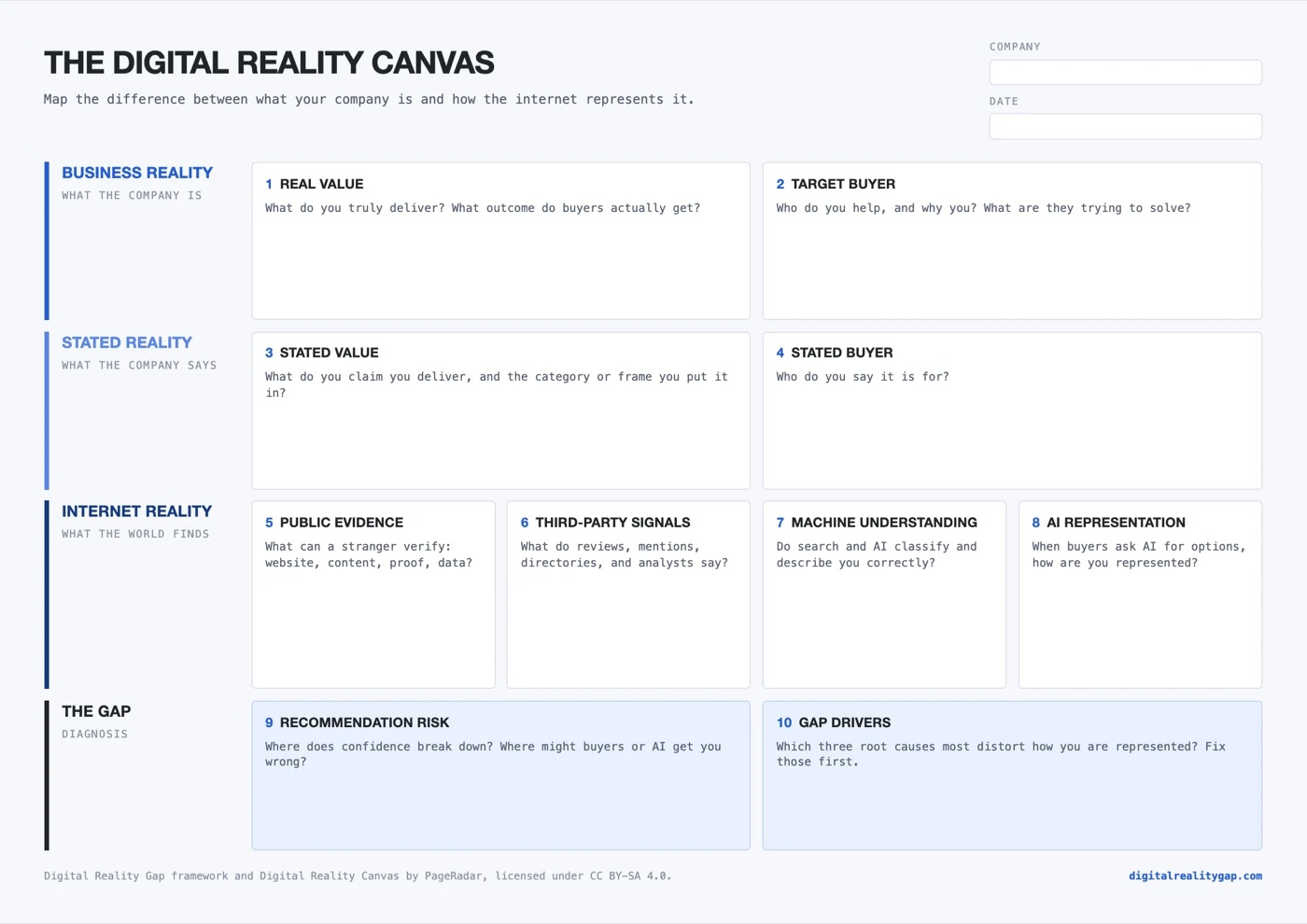
One page, ten blocks, four bands. Print it, fill it with your team, and read the distance between the top and the middle.
Download the Digital Reality CanvasEvery answer on a filled Canvas carries its source: Declared, Observed, Perceived, Evidenced or Unknown. See a filled Canvas
Run a Digital Reality Check
The Check tests your most important claims against the same search results and AI answers your buyers see. One afternoon, no tools.
Ask AI: "What are the best options for [the problem your buyer is solving]?"
If you are not in the answer, you have a gap. If you are in it and described wrongly, you have a different one.
Search and AI are rarely randomly wrong. They repeat the evidence available to them, including the evidence you published.
What the Check produces: A Canvas Readout · The claims that are wrong, stale or missing · Likely gap drivers · Your top three next moves
The Digital Reality Score
One company-level number for one question: how closely do Business Reality, Stated Reality and Internet Reality agree? It is calculated from evidence, claim by claim, rather than from your own Canvas.
The full version of the Check. Every important claim is traced across sources and its evidence recorded. The Digital Reality Score applies the same discipline at company level, and publishes how.
Higher means more aligned
The Digital Reality Score reads as alignment: 100 would mean the internet represents the company exactly as it is. Publish it with a band, never on its own.
- 85–100Aligned
- 70–84Minor gap
- 50–69Moderate gap
- 0–49Significant gap
A number implies a precision the evidence rarely supports. The band is the honest part, and it is what survives being repeated.
Common Digital Reality gaps
Eight patterns account for most of what a Check finds. Each is read between two blocks of the Canvas.
Customers cannot find a product you already offer, because your own pages undersell or omit it.
Real Value ↔ Stated ValueYou now sell to a different buyer than the one your public record describes.
Target Buyer ↔ Stated BuyerSearch and AI file you under the wrong category, next to the wrong competitors.
Stated Value ↔ Machine UnderstandingA claim is true and stated, and nothing independent confirms it.
Real Value ↔ Public EvidenceA rebrand, acquisition or leadership change is still propagating months later.
Business ↔ Internet RealityDatabases and knowledge graphs contradict your website, so nothing resolves cleanly.
Machine Understanding ↔ Third-Party SignalsCompetitors are more strongly associated with the category you built.
AI Representation ↔ Third-Party SignalsAI repeats outdated positioning, or describes you differently by market and language.
Real Value ↔ AI RepresentationHow gaps are closed
Gaps close at the source, in order. Asking an AI system to say something different changes nothing it will tell the next person.
- 1
Verify the truth
Confirm the claim with the people who own it. Record who confirmed it, and when.
- 2
Correct what you control
Website, structured data, press pages and your own profiles, consistently.
- 3
Correct the external record
Databases, directories, Wikidata and partner pages, where you are entitled to and the process allows it.
- 4
Build evidence
Give authoritative third parties a source they can cite, so the claim stands without you.
- 5
Watch it propagate
Re-run the same queries later. Propagation takes weeks to months, and some sources never update.
Brand, communications, SEO, web and partnerships each own part of this. The framework tells them what to fix first.
Digital reality is not static
Your company keeps changing, and so do the sources that describe it. Pages age, databases are re-imported, models are retrained and competitors publish. A gap closed this quarter can reopen after the next launch, reorganisation or acquisition.
- Product launches
- Rebrands
- Acquisitions
- Leadership changes
- Website migrations
- New markets
Continuous monitoring can detect new gaps as they appear, which is what PageRadar SIGNAL does.
Everything you need is published
The framework is open. You can apply it independently, adapt it, and use it in client work.
- GuideHow to run a Digital Reality Check
- ExampleA Check, start to finish
- ExampleZero AI Share of Voice, worked through
- TemplateThe Digital Reality Canvas, with a filled example
- MeasureThe Digital Reality Score, and how it is calculated
- DataThe framework as JSON
- AnswersFrequently asked questions
How the method stays honest
- Published queriesThe exact questions, the two-chat protocol, and how to tally them.
- Repeated observationsAI answers vary. One run is an anecdote, so the method asks for repetitions and a date.
- Evidence before judgementRecord what was observed and where, separately from what you concluded.
- Open licenceFramework and Canvas under CC BY-SA 4.0, commercial use included.